

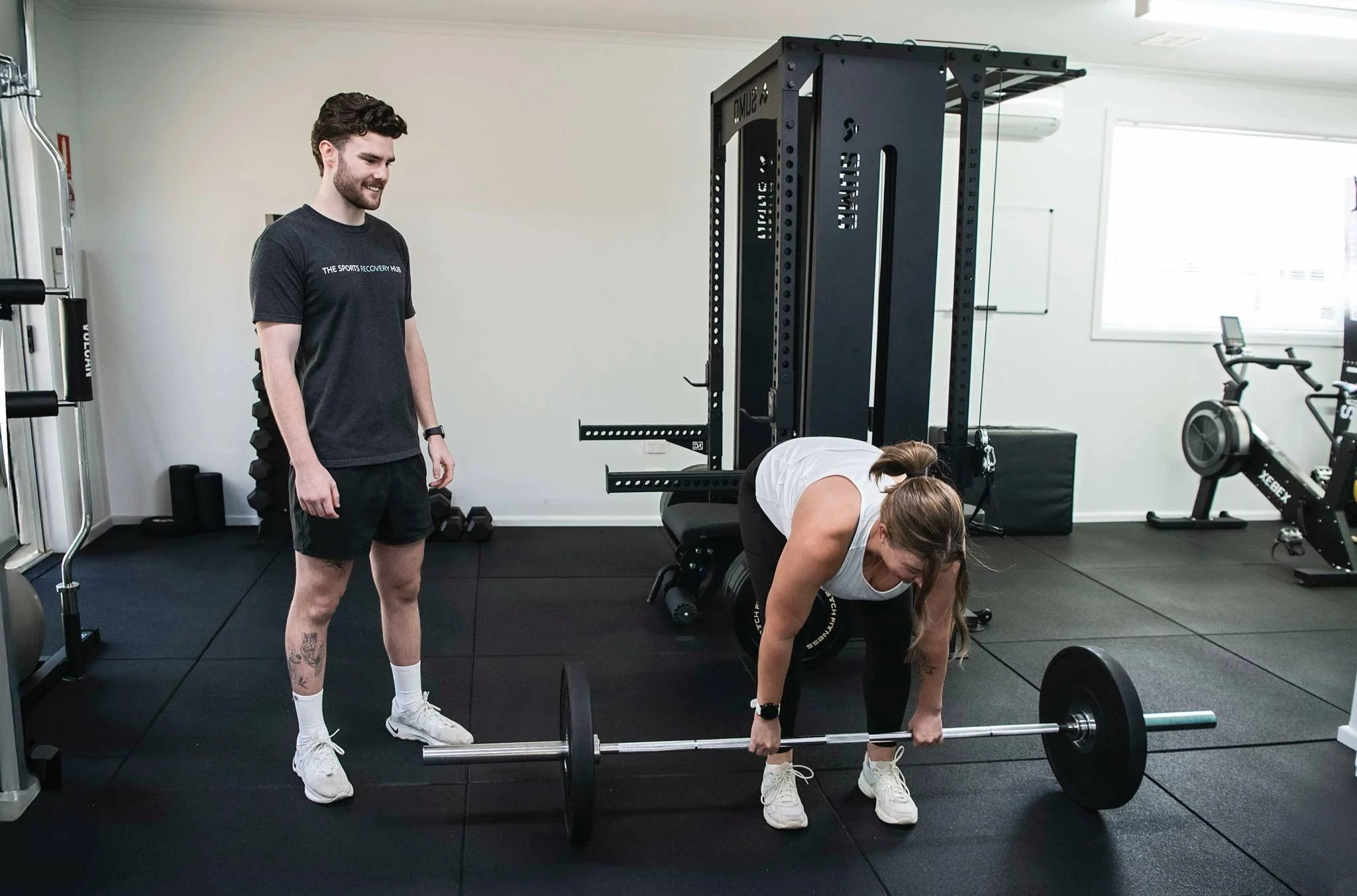
PHYSIOTHERAPY
Assessment, Rehabilitation & Performance-Focused Care
At The Sports Recovery Hub, our Physiotherapists help people recover from injury, return to sport, optimise performance, and build long-term resilience.
Whether you're recovering from surgery, managing a sporting injury, dealing with persistent pain, or looking to improve movement and strength, our approach combines thorough assessment, hands-on treatment, and evidence-informed rehabilitation.
Based in Keilor, we work with active individuals, workers, runners, and athletes throughout Melbourne's western suburbs to help them move with confidence and return to the activities they enjoy.
How Physiotherapy Can Help
Our Physiotherapists assess, diagnose, and manage a wide range of musculoskeletal and sporting conditions.
Treatment may include:
Comprehensive assessment
Exercise rehabilitation
Strength and conditioning
Manual therapy
Dry needling
Mobility restoration
Running assessments
Return-to-sport planning
Load management strategies
Injury prevention programs
Every treatment plan is tailored to your goals, lifestyle, and current capacity.
Conditions We Commonly Treat
Neck pain
Tendinopathies
Post-operative rehabilitation
Persistent pain conditions
Post-Operative Rehabilitation
Successful surgery is only one part of the recovery process. A structured rehabilitation plan is often critical for achieving the best possible outcome.
Our Physiotherapists regularly assist patients recovering from:
ACL Reconstruction
Rehabilitation following ACL reconstruction focuses on restoring knee range of motion, strength, power, running capacity, change of direction ability, and confidence before returning to sport.
Shoulder Reconstruction & Stabilisation Surgery
Whether you've undergone labral repair, rotator cuff surgery, or shoulder stabilisation procedures, rehabilitation aims to restore mobility, strength, function, and confidence in overhead activities and sport.
Hip Surgery
Following procedures such as hip arthroscopy, labral repair, or hip reconstruction, rehabilitation focuses on restoring movement quality, strength, stability, and return-to-sport capacity.
Frozen Shoulder & Hydrodilatation Rehabilitation
Hydrodilatation can be an effective procedure for some individuals with frozen shoulder. Physiotherapy plays an important role in maintaining improvements in shoulder mobility, restoring strength, and improving functional movement following the procedure (Challoumas et al., 2020).
Running & Sports Rehabilitation
Our Physiotherapists work with athletes across a variety of sports including:
AFL Football
Netball
Running
Soccer
Basketball
Tennis
CrossFit
Strength Sports
Whether you're preparing for competition or recovering from injury, rehabilitation programs are designed around the specific demands of your sport.
Our Treatment Philosophy
At The Sports Recovery Hub, we believe long-term outcomes are achieved through a combination of education, movement, strength, and progressive rehabilitation.
Rather than relying solely on passive treatment, we focus on helping you:
Understand your condition
Improve movement quality
Build physical capacity
Return to work
Return to sport
Reduce injury recurrence
Our goal is to help you become more confident, capable, and independent throughout your recovery journey.
Frequently Asked Questions
Do I need a referral to see a Physiotherapist?
No. Physiotherapists are primary healthcare practitioners, meaning you can book directly without a referral from a doctor.
Is physiotherapy evidence-based?
Yes. Physiotherapy is built around assessment, diagnosis, exercise rehabilitation, patient education, and evidence-informed treatment approaches. Exercise therapy remains one of the most effective interventions for many musculoskeletal conditions (Hayden et al., 2021; Foster et al., 2018).
How long will rehabilitation take?
Recovery time varies depending on the injury, surgery, goals, and individual factors. Some conditions improve within a few weeks, while post-operative rehabilitation may take several months. Your Physiotherapist will provide guidance based on your specific situation.
Can physiotherapy help me avoid surgery?
In some cases, yes. Research has shown that structured rehabilitation programs can improve pain and function for many musculoskeletal conditions and may help some individuals avoid or delay surgery (Foster et al., 2018; van Middelkoop et al., 2011).
When can I return to sport after surgery?
Return-to-sport decisions should be based on objective testing, strength, function, confidence, and sport-specific capacity rather than time alone. Research supports criterion-based rehabilitation to reduce reinjury risk and improve long-term outcomes following surgery (Ardern et al., 2016).
Why Choose The Sports Recovery Hub?
Our Physiotherapists combine hands-on treatment with evidence-informed rehabilitation to help people recover from injury and return to the activities they enjoy.
We focus on:
Individualised rehabilitation plans
Sports injury management
Post-operative rehabilitation
Strength and conditioning
Running rehabilitation
Return-to-sport testing
Long-term injury prevention
Book a Physiotherapy Assessment
Whether you're recovering from surgery, managing an injury, preparing for a sporting event, or simply looking to move better, our Physiotherapists can help guide you through the process with a personalised assessment and rehabilitation plan.
Book a Physiotherapy appointment today and take the next step towards recovery, performance, and long-term health.
-
Brinjikji, W., Luetmer, P. H., Comstock, B., Bresnahan, B. W., Chen, L. E., Deyo, R. A., Halabi, S., Turner, J. A., Avins, A. L., James, K., Wald, J. T., Kallmes, D. F., & Jarvik, J. G. (2015). Systematic literature review of imaging features of spinal degeneration in asymptomatic populations. American Journal of Neuroradiology, 36(4), 811–816.
Chiu, C. C., Chuang, T. Y., Chang, K. H., Wu, C. H., Lin, P. W., & Hsu, W. Y. (2015). The probability of spontaneous regression of lumbar herniated disc: A systematic review. Clinical Rehabilitation, 29(2), 184–195.
Coulter, I. D., Crawford, C., Hurwitz, E. L., Vernon, H., Khorsan, R., Booth, M. S., & Herman, P. M. (2018). Manipulation and mobilization for treating chronic low back pain: A systematic review and meta-analysis. Spine Journal, 18(5), 866–879.
Foster, N. E., Anema, J. R., Cherkin, D., Chou, R., Cohen, S. P., Gross, D. P., Ferreira, P. H., Fritz, J. M., Koes, B. W., Peul, W., Turner, J. A., & Maher, C. G. (2018). Prevention and treatment of low back pain: Evidence, challenges, and promising directions. The Lancet, 391(10137), 2368–2383.
Hayden, J. A., Ellis, J., Ogilvie, R., Malmivaara, A., & Van Tulder, M. W. (2021). Exercise therapy for chronic low back pain. Cochrane Database of Systematic Reviews, 9(9), CD009790.
Oliveira, C. B., Maher, C. G., Pinto, R. Z., Traeger, A. C., Lin, C. W. C., Chenot, J. F., van Tulder, M., & Koes, B. W. (2018). Clinical practice guidelines for the management of non-specific low back pain in primary care: An updated overview. European Spine Journal, 27(11), 2791–2803.
Oliveira, C. B., Maher, C. G., Ferreira, M. L., Hancock, M. J., Oliveira, V. C., McLachlan, A. J., Koes, B. W., & Ferreira, P. H. (2020). Epidural corticosteroid injections for lumbosacral radicular pain. Cochrane Database of Systematic Reviews, 4(4), CD013577.
Paige, N. M., Miake-Lye, I. M., Booth, M. S., Beroes, J. M., Mardian, A. S., Dougherty, P., Branson, R., Tang, B., & Shekelle, P. G. (2017). Association of spinal manipulative therapy with clinical benefit and harm for acute low back pain. JAMA, 317(14), 1451–1460.
Zhong, M., Liu, J. T., Jiang, H., & Mo, W. (2017). Incidence of spontaneous resorption of lumbar disc herniation: A meta-analysis. Pain Physician, 20(1), E45–E52.