

CHIROPRACTIC
Evidence-Informed Chiropractic Assessment, Treatment & Rehabilitation
At The Sports Recovery Hub in Keilor, our approach to chiropractic care is centred around helping people move better, build resilience, and return to the activities that matter most.
Whether you're dealing with back pain, neck pain, headaches, sports injuries, dizziness, or movement limitations, our Chiropractors take a comprehensive approach that combines assessment, hands-on treatment, exercise rehabilitation, and patient education.
We work with active individuals, workers, and athletes throughout Melbourne's western suburbs who are looking for a personalised and evidence-informed approach to managing pain, injury, and performance.
What Is Chiropractic Care?
Chiropractic is a healthcare profession focused on the assessment, diagnosis, management, and rehabilitation of musculoskeletal conditions.
While many people associate chiropractic care with spinal manipulation or "adjustments," modern chiropractic care often incorporates a wide range of treatment approaches depending on the individual's presentation and goals.
At The Sports Recovery Hub, treatment may include:
Comprehensive assessment
Joint mobilisation
Chiropractic adjustments where appropriate
Soft tissue therapy
Dry needling
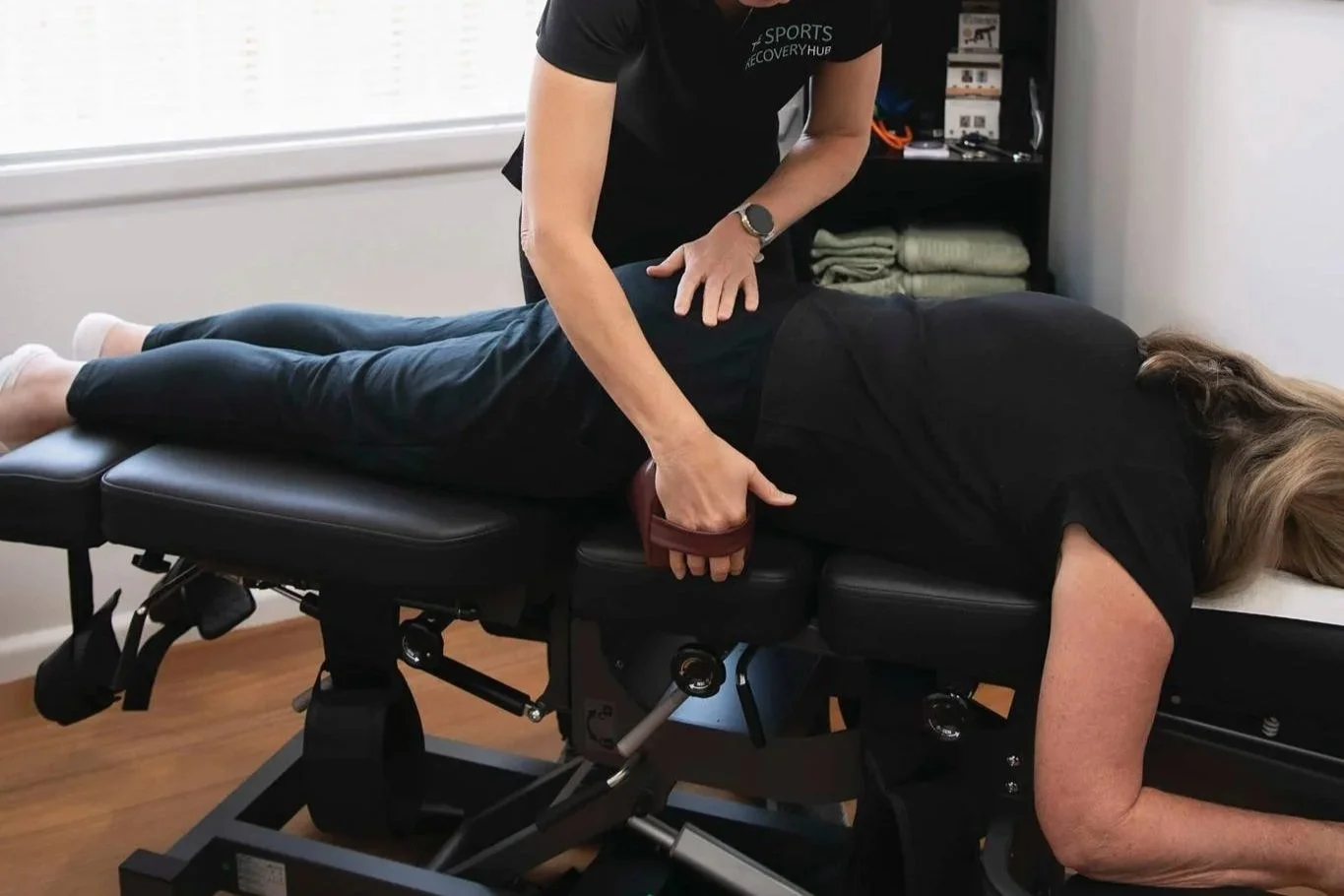
Flexion-distraction therapy
Neuro-orthopaedic rehabilitation
Mobility programs
Strength and rehabilitation exercises
Return-to-sport planning
Load management strategies
Every treatment plan is tailored to the individual rather than applying a one-size-fits-all approach.
What Conditions Can Chiropractic Care Help With?
Our Chiropractors regularly assess and manage a variety of musculoskeletal conditions, including:
Spine Conditions
Joint stiffness
Postural complaints
Headaches & Dizziness
Cervicogenic headaches
Dizziness
Balance complaints
Sports & Exercise Injuries
Neurological & Neuro-Orthopaedic Conditions
Persistent pain presentations
Movement control impairments
Balance dysfunction
Functional neurological rehabilitation
How We Assess Patients
A thorough assessment forms the foundation of effective treatment.
Your consultation may include:
Detailed history taking
Orthopaedic examination
Neurological assessment
Mobility testing
Strength assessment
Functional movement analysis
Balance and coordination testing
Sport-specific assessment where appropriate
Understanding the factors contributing to your symptoms allows us to develop a treatment plan tailored to your goals and lifestyle.
Our Treatment Philosophy
At The Sports Recovery Hub, we believe successful outcomes come from combining symptom management with active rehabilitation.
Rather than focusing solely on short-term pain relief, our goal is to help you:
Move more confidently
Improve physical capacity
Build strength and resilience
Return to work
Return to sport
Reduce the likelihood of recurrence
We recognise that every person responds differently to treatment, which is why care is individualised based on your presentation, goals, and preferences.
Chiropractic Adjustments
Spinal manipulation, commonly referred to as an adjustment, is one tool that may be used as part of a broader management plan.
Research suggests spinal manipulation can provide benefits for some individuals experiencing low back pain and neck pain when used alongside exercise, education, and rehabilitation strategies (Paige et al., 2017; Coulter et al., 2018).
Not every patient requires an adjustment, and treatment decisions are made collaboratively based on clinical findings and patient preference.
Flexion-Distraction Therapy
Flexion-distraction is a gentle, non-force spinal decompression technique commonly used for lumbar disc injuries, sciatica, and nerve-related symptoms.
This approach may help:
Improve spinal mobility
Reduce mechanical sensitivity
Encourage comfortable movement
Support rehabilitation and recovery
Flexion-distraction is often combined with mobility work and exercise rehabilitation as part of a comprehensive treatment approach.
Neuro-Orthopaedic Rehabilitation
Our Chiropractors utilise neuro-orthopaedic rehabilitation principles, including approaches informed by functional neurology and neuro-rehabilitation, to assess and improve movement quality, balance, coordination, and function.
Depending on your presentation, rehabilitation may include:
Balance training
Eye movement exercises
Vestibular rehabilitation
Movement retraining
Mobility restoration
Strength-based rehabilitation
This approach can be particularly useful for individuals experiencing dizziness, headaches, persistent pain, post-concussion symptoms, or complex movement dysfunction.
Chiropractic Care and Exercise Rehabilitation
Research consistently demonstrates that exercise is one of the most effective interventions for many musculoskeletal conditions (Hayden et al., 2021; Foster et al., 2018).
For this reason, rehabilitation forms a central component of our chiropractic approach.
Your rehabilitation program may include:
Mobility exercises
Strength training
Core conditioning
Walking programs
Return-to-running progressions
Sport-specific rehabilitation
Injury prevention strategies
The aim is to improve long-term outcomes rather than relying solely on passive treatment.
Chiropractic Care for Athletes
Our Chiropractors regularly work with:
AFL Footballers
Netballers
Runners
Cyclists
Powerlifters
CrossFit Athletes
Tennis Players
Recreational Gym-Goers
Whether you're managing an injury, returning to competition, or looking to optimise performance, treatment and rehabilitation can be tailored to the specific demands of your sport.
Frequently Asked Questions
Do I need to be adjusted?
No. Chiropractic care involves much more than spinal adjustments. Depending on your condition and goals, treatment may focus on rehabilitation, mobility work, soft tissue therapy, dry needling, education, or exercise prescription. Current clinical guidelines support a multimodal approach to managing musculoskeletal conditions, combining manual therapy with exercise and self-management strategies where appropriate (Oliveira et al., 2018).
Is chiropractic safe?
Chiropractic care is considered safe when provided by a registered healthcare professional. As with any healthcare intervention, there are potential risks and benefits, which will be discussed during your consultation. Serious adverse events associated with chiropractic treatment are considered rare (Carnes et al., 2010).
Will I need ongoing treatment forever?
No. At The Sports Recovery Hub, our goal is to help you become more independent and self-sufficient. While some people choose periodic maintenance care, research consistently demonstrates that education, self-management, exercise, and active rehabilitation play important roles in long-term musculoskeletal health and reducing recurrence of symptoms (Foster et al., 2018; Hayden et al., 2021).
Is chiropractic evidence-based?
Modern chiropractic care incorporates evidence-informed assessment, treatment, exercise rehabilitation, and patient education. Current clinical guidelines support the use of manual therapy alongside exercise and self-management strategies for many musculoskeletal conditions, including low back pain and neck pain (Oliveira et al., 2018; Coulter et al., 2018).
Should I see a Chiropractor or Physiotherapist?
The most important factor is finding the right practitioner for your goals and preferences rather than focusing solely on the profession itself.
Research suggests that positive healthcare outcomes are influenced by factors such as accurate diagnosis, evidence-based treatment, exercise rehabilitation, patient education, and a strong therapeutic alliance between practitioner and patient (Foster et al., 2018).
At The Sports Recovery Hub, our Chiropractors and Physiotherapists share a similar philosophy centred around assessment, education, rehabilitation, exercise, and helping people return to the activities they enjoy.
While each profession has different training pathways and may utilise different techniques, both can play an important role in managing musculoskeletal conditions when treatment is guided by current evidence and tailored to the individual.
Many people searching for a chiropractor or physiotherapist are ultimately looking for the same thing. This clinician can accurately diagnose the problem, provide effective treatment, and guide them back to doing what they love.
Can chiropractic care help with headaches and migraines?
Some headaches can originate from structures in the neck, commonly referred to as cervicogenic headaches. Research suggests that a combination of manual therapy, exercise, and movement rehabilitation may be beneficial for some individuals experiencing neck-related headaches (Bryans et al., 2011).
Migraine management often requires a multidisciplinary approach, with treatment focusing on identifying triggers, improving lifestyle factors, and addressing contributing musculoskeletal dysfunction where appropriate.
Can chiropractic care help with dizziness or vertigo?
Certain forms of dizziness may be related to neck dysfunction, balance impairments, vestibular conditions, or changes in sensory processing. Assessment and rehabilitation strategies aimed at improving balance, coordination, eye movements, and movement confidence may assist some individuals depending on the underlying cause of their symptoms. A thorough assessment is important to determine whether chiropractic care is appropriate for your presentation.
Why Choose The Sports Recovery Hub?
Our Chiropractors combine hands-on care with active rehabilitation to help patients move better, recover from injury, and improve long-term function.
We focus on:
Evidence-informed care
Individualised treatment plans
Rehabilitation and exercise
Collaborative multidisciplinary care
Return-to-work planning
Return-to-sport progression
Long-term resilience and self-management
From our clinic in Keilor, we provide a modern approach to chiropractic care that goes beyond simply treating symptoms.
Book a Chiropractic Assessment
Whether you're dealing with back pain, neck pain, headaches, sports injuries, dizziness, movement limitations, or looking to improve your physical performance, our team can help identify the underlying contributors and develop a personalised management plan.
Book a chiropractic assessment today and take the first step towards moving better, feeling stronger, and returning to the activities you enjoy.
-
Bryans, R., Descarreaux, M., Duranleau, M., Marcoux, H., Potter, B., Ruegg, R., Shaw, L., Watkin, R., & White, E. (2011). Evidence-based guidelines for the chiropractic treatment of adults with headache. Journal of Manipulative and Physiological Therapeutics, 34(5), 274–289.
Carnes, D., Mars, T. S., Mullinger, B., Froud, R., & Underwood, M. (2010). Adverse events and manual therapy: A systematic review. Manual Therapy, 15(4), 355–363.
Coulter, I. D., Crawford, C., Hurwitz, E. L., Vernon, H., Khorsan, R., Booth, M. S., & Herman, P. M. (2018). Manipulation and mobilization for treating chronic low back pain: A systematic review and meta-analysis. The Spine Journal, 18(5), 866–879.
Foster, N. E., Anema, J. R., Cherkin, D., Chou, R., Cohen, S. P., Gross, D. P., Ferreira, P. H., Fritz, J. M., Koes, B. W., Peul, W., Turner, J. A., & Maher, C. G. (2018). Prevention and treatment of low back pain: Evidence, challenges, and promising directions. The Lancet, 391(10137), 2368–2383.
Hayden, J. A., Ellis, J., Ogilvie, R., Malmivaara, A., & van Tulder, M. W. (2021). Exercise therapy for chronic low back pain. Cochrane Database of Systematic Reviews, 9(9), CD009790.
Oliveira, C. B., Maher, C. G., Pinto, R. Z., Traeger, A. C., Lin, C. W. C., Chenot, J. F., van Tulder, M., & Koes, B. W. (2018). Clinical practice guidelines for the management of non-specific low back pain in primary care: An updated overview. European Spine Journal, 27(11), 2791–2803.
Paige, N. M., Miake-Lye, I. M., Booth, M. S., Beroes, J. M., Mardian, A. S., Dougherty, P., Branson, R., Tang, B., & Shekelle, P. G. (2017). Association of spinal manipulative therapy with clinical benefit and harm for acute low back pain. JAMA, 317(14), 1451–1460.